

A gentle guide for survivors of abuse and domestic violence — wherever you are in your journey.
You don’t have to be ready. You don’t have to be healed. You don’t even have to know what you want to say. Your story is already alive inside you — this guide is simply here to help you find a door.
I wrote my first real words about what happened to me in the dark, alone, in a notebook I kept hidden under my pillow. They weren’t beautiful words. They weren’t even complete sentences. They were an ugly testament to my undeserved neglect and abuse. But they were true, and that was the first time I understood what it means to be a witness to your own life.

Writing was taken from me. I had to find it again
I was always a writer. Long before I understood what I was processing, before I had the language for what I’d survived, I wrote. It was the place I could tell the truth when no one and nowhere else felt safe.
But a parent took that from me. Not only the notebooks, the belief that I had something worth saying. The permission to speak. For years after I escaped, the page felt foreign. Dangerous. Like claiming a voice I’d been told I didn’t have.
Getting it back wasn’t one moment. It was many tries. Many failures. Many drafts I deleted and journals I abandoned, with half-formed thoughts I let die before they could become something I was still afraid would be seen. And then, slowly, something in me pushed me back to the page. A digital page.
What I want you to remember is this: finding your voice is not a straight line. It is a long, circling return. And every attempt, even the ones that go nowhere, is part of the journey back home to yourself.
Internal Steps
The attempt
You try but it feels wrong, forced, too small or too large. You stop. This is not failure — this is just the beginning.
The silence
You leave it alone. Weeks. Maybe months. The story waits. It is patient in a way you haven’t learned to be with yourself yet.
The return
Something pulls you back. A dream or perhaps a line from a song. It comes in a moment of stillness. You write one sentence and it sounds like you, so you write another.
The keeping
You keep it this time. Not because it’s perfect but because it’s yours. And that is everything
01
First, a permission slip

Before you write a single word, know this: you are allowed. Allowed to tell it. Allowed to leave parts out. Allowed to be messy, nonlinear, incomplete. Allowed to cry. Allowed to stop. Allowed to feel angry and lost.
Writing your story is not a performance and should start for no one else but you. There is no correct version. What happened to you was real, and you are the only one who lived inside it. That makes you the only one who can tell it.
“Everything in my life feels so upside down.
What is the point of this existence if all it brings is constant pain and suffering? Happiness? Because that lasts so long?
Why does everything feel like a dream? Or a nightmare?
Why am I such a child?
I came from nothing. I am nothing. I am barely a person. When will I find myself?
“
— Belinda, SoulSprouts, Grief Pt. 2
Gentle Starting Prompts
What is one thing you want someone to understand about what you lived through?
If your story were a weather pattern, what would it look like?
What is something you believed about yourself then that you know differently now?
02
You don’t have to start at “the beginning”
We are taught that stories have beginnings, middles, and ends; neat arcs with tidy resolution. But survival doesn’t work that way. Neither does healing.
You can start anywhere. The moment that everything changed and that memory keeps coming back to you. A sound you still flinch at. The first morning you woke up and something felt different. Start where the heart leads.
“In depression I feel as though I’ve lost myself. I don’t recognize who I used to be anymore. Only who I’ve become, barely a soul.“
— Belinda, SoulSprouts, Loss of Identity
What’s a moment, image, or detail that won’t leave you alone?
Where in your body do you hold this story? What does that place want to say?
What is the sentence you’ve been afraid to write?
03
Writing was my lifeline — and it can be yours
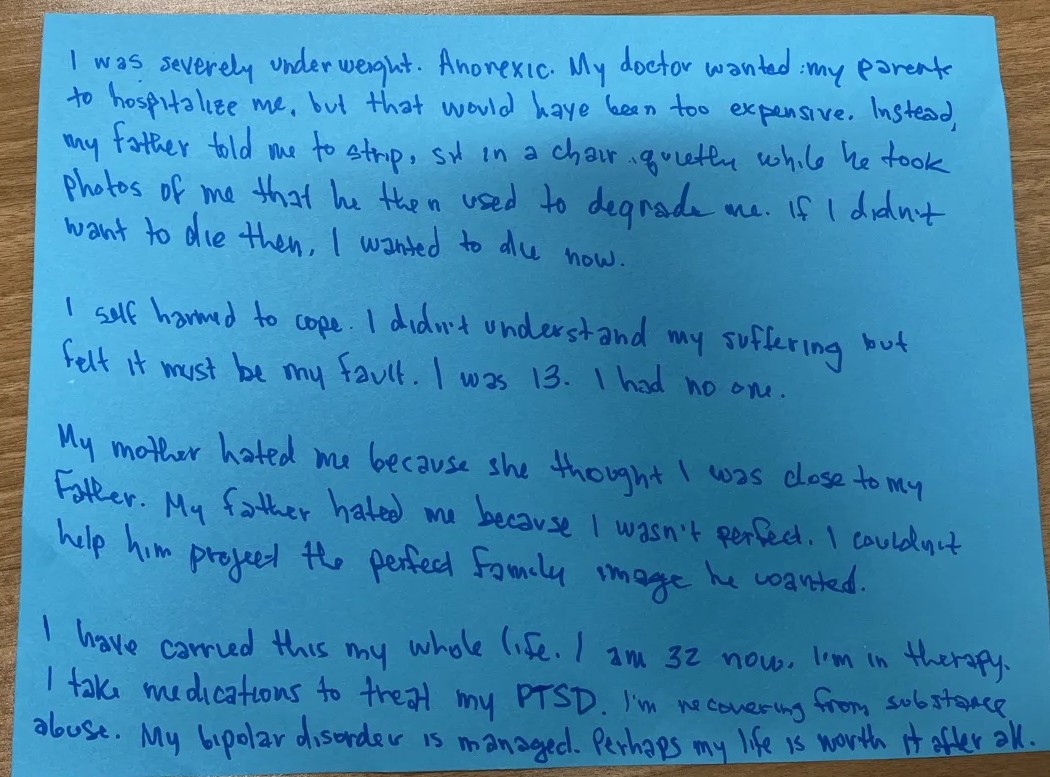
There were nights when writing was the only thing that kept me here. Not because I was writing beautifully, I wasn’t. But because putting words on a page meant I was still speaking. Still present. Still refusing to disappear.
Writing doesn’t fix what happened. It doesn’t erase it or make it make sense. But it does something equally important: it says I was here, and this was real. It creates a witness when the world refused to be one.
“Mother
A storm has passed
However it has left a lot of grief behind in its wake
Like lost time not realizing who my mother was. A benevolent angel
Can I make up lost time? I feel so lost.
“
— Belinda, SoulSprouts, Insomnia
Writing Through the Hard Parts
Write about that time as if it happened to someone you love. What do you want them to know?
What did you need in that moment that no one gave you? Can you give it to yourself now, on the page?
What’s one true thing — even a small one — you can say about that time? Where were you? How did you feel?
🌿
A gentle reminder
You are not obligated to share anything you write. Some words are just for you. The act of writing is healing on its own. An audience can come later, or never. Both are whole and right.
04
Finding the thread of meaning
At some point — not necessarily right away, maybe much later — you may find yourself asking: what does this mean? Not why it happened (that question rarely has a satisfying answer), but what you made of it. Who you became in spite of it.
This is where survival becomes a story. Not because suffering has a silver lining, it doesn’t always, but because you have continued. You made meaning, even in the fragments.
“As I drove away from the empty Church lot, it dawned on me, something I forgot, that there was absolutely not, a single thing to change about me“
— Belinda, SoulSprouts, Not a Single Thing
Finding Meaning Without Forcing It
What do you know now that you couldn’t have learned any other way?
Who are you becoming because of — and in spite of — what happened?
If your past self could see you today, what would surprise her most?
05
If you choose to share it

Sharing your story is a brave act. It is also a choice, one that belongs entirely to you. You don’t owe anyone your pain as proof of what you survived. But if you’re called to share, know that you will likely reach someone who needs to hear exactly what you have to say.
Write for one person. Picture one reader who is sitting exactly where you once sat. Write toward her. That specificity is what makes stories feel universal.
You don’t have to include everything. Sharing a piece of your story is not the same as sharing all of it. Curate with care, with intention, with love for yourself.
Protect yourself first. You are not required to be raw for anyone else’s comfort. Share what feels grounded. The rest is sacred and yours to keep.
Preparing to Share
Who are you writing this for? What do you hope they feel when they finish reading?
What part of this story feels most important to offer — and what do you want to keep for yourself?
What would it mean to you if one person read this and felt less alone?
Your story is already worthy
You survived something tremendous and yet, you are here. And the act of putting words to your experience, even in a private notebook, even in fragments, even badly, is a form of reclaiming yourself.
There is no rush. There is no right way. There is only the next word, and then the one after that.
If you’re ready to share your story with our community, we are here and we are listening.
“I was not born silent.
I was silenced.
And I found my way back to words.”
— Belinda, SoulSprouts

What are your thoughts? We want to know!